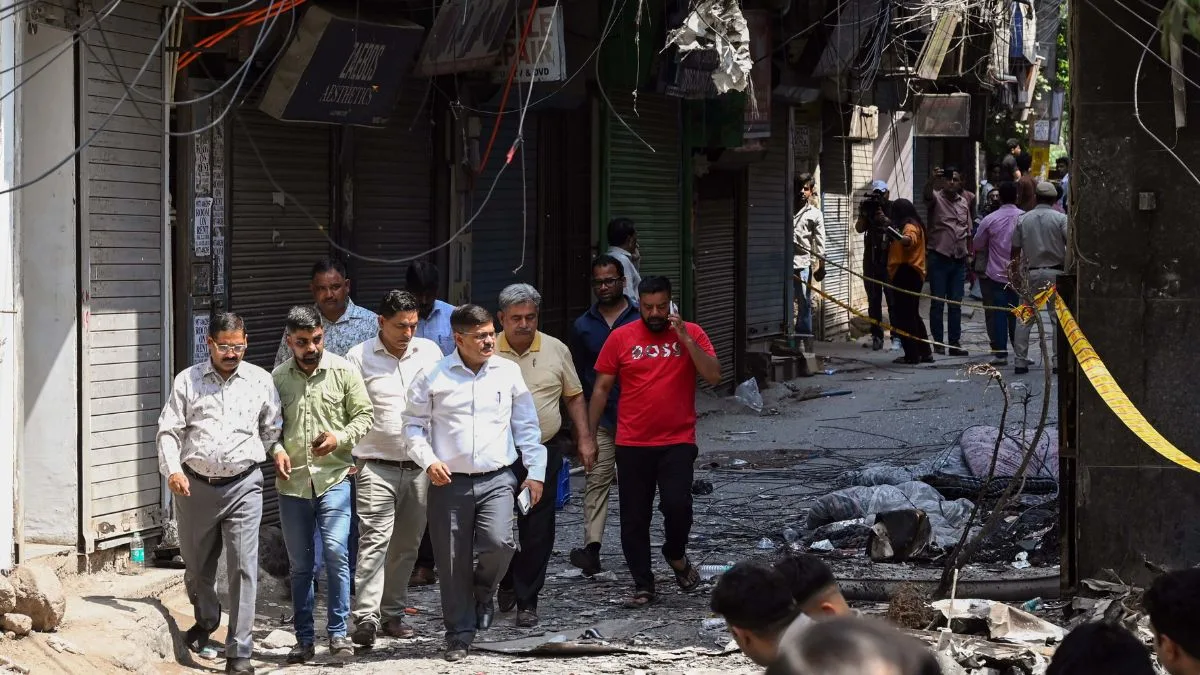
Investigators looking into the November 10 explosion near Delhi’s Red Fort have now firmly established a Jaish-e-Mohammad (JeM) connection. According to officials, the accused received instructions on assembling the device from a JeM operative who had been guiding them remotely.
What has alarmed agencies even more is the scale of the conspiracy that has begun to surface. The group was allegedly working on as many as 200 explosive devices intended for simultaneous detonation across Delhi, Gurugram, Faridabad, and other parts of North India. Officials say the Inter-Services Intelligence (ISI) had specifically chosen a JeM operative to mentor the accused, who were a part of the Faridabad module.
Advertisement
Investigators have identified this trainer as Hanzulla, a figure described by officials as a “big name” in JeM. His name had earlier appeared on posters put up in Jammu and Kashmir, where he was described as “Commander Hanzulla Bhai”.
Those posters, officers said, were a crucial early clue that eventually led to the module’s exposure and the recovery of nearly 2,900 kg of bomb-making material and ammonium nitrate.
Also Read: Delhi blast accused Umar assembled bomb inside Hyundai i20 car at Red Fort parking: Report
The module, the operatives, and the plot
News agency IANS mentioned that according to the probe, Hanzulla was in direct contact with Maulvi Iran Ahmed, who facilitated communication between him and the Faridabad group. Ahmed also linked him to Shakeel, the man who procured materials as instructed and later transported explosives. Shakeel is the one who supplied the white Hyundai i20 that was used in the Red Fort blast.
One officer revealed that the group was preparing highly lethal devices based on instructions from Hanzulla, who told them to combine ammonium nitrate with Triacetone triperoxide (TATP).
Officials note that this mixture creates a powerful explosive that requires very little technical skill to assemble and can be triggered with minimal effort. Because of how easily it can detonate, even through heat, such explosives have been frequently used by Islamic State Khorasan Province (ISKP), especially for attacks involving lone actors or vehicles left in crowded public places.
Investigators believe the Faridabad module planned to set off all 200 bombs at the same time, and the quantity of ammonium nitrate recovered aligns with this assessment. An officer, in the meantime, said that the ramifications of a successful execution of the plan would have been catastrophic.
Where Hanzulla is operating from remains unclear. What the investigation has established so far is that Ahmed coordinated from Kashmir and that another handler based in Afghanistan was also involved. The group kept its activities concealed by relying on secure messaging platforms and coded terminology. “Biriyani”, for instance, was used as a word for explosives.
The module also avoided detection because many members were medical professionals. Their occupations helped them stay under the radar.
One of them, Dr Shaheen, is said to have played a critical role in recruiting others. Despite multiple trips to Jammu and Kashmir, she remained unnoticed because of her profession. During these visits, she reportedly met Ahmed frequently, receiving guidance on strengthening the group with more “white-collar” recruits.
Investigation teams are now working to trace the movements of Hanzulla and identify his exact location.